What’s on the other side?

As we go through life we are confronted with all kinds of situations, some good some bad. Often we know how to deal with things and are pretty sure of the outcome of our decisions.
There are times, however, when the decisions we make are based on assumptions.
This struck me the other day when I was reading again the story of Lazarus in the Bible. (John’s Gospel, Chapter 11.) Lazarus, you recall, was the guy who rose from the dead, at Jesus’ command.
By the time Jesus arrived Lazarus had been dead for 4 days, and yet He asked where the tomb was, and when they arrived Jesus said, “Take ye away the stone”. Martha, the sister of him that was dead, saith unto him, “Lord, by this time he stinketh: for he hath been dead four days.” (John 11:39 KJV)
Martha assumed she KNEW what was behind the stone, and even though she believed Jesus was the Messiah, she still had a very human attitude towards the situation.
Of course, there was no stink, and Lazarus came out alive.
So what about the ‘stones’ in your life ? Are you facing, with dread, a situation, where you are assuming and expecting the worst? You will never really know what is at the other side until you put your trust in Jesus and ‘Roll the Stone away’.
It doesn’t say anything about a stink in the bible, but I like to think if there was a smell from Lazarus’ tomb, it would have been a sweet, refreshing one!
Regards and Blessings,

Bill Lee
King’s Lynn Christian Fellowship
In the bleak midwinter

The nights are drawing in, it’s getting colder, heralding the approach of winter and Christmas. This is a busy time of the year, when we prepare for the celebration of the birth of our Lord Jesus Christ.

In one of my favourite Christmas carols, ” In The Bleak Mid – Winter “, Christina G. Rossetti (1830 -1894) describes the Nativity scene in winter in her own imagery.

Due to unforseen circumstances life can be cold, bleak and hopeless for some of us, with one problem after another just like “snow on snow, in a bleak mid – winter”.

When everything seems so cold and dreary Jesus came to give us hope.

The last verse in the carol captures my attention.
“What can I give Him, poor as I am,
If I were a shepherd, I would bring a lamb,
If I were a wise man,I would do my part,
Yet what I can, I give Him-
Give my heart”

Personally, giving my heart means to believe that Jesus is the Son of God, and to trust and love Him. I can lay all my cares, hurts and sorrows at His feet and receive His Peace , Joy and Love.

Jesus said,”I am the Light of the world. Whoever follows me will never walk in darkness but will have the light of life”. John Chapter 8 .verse.12.

Jesus invites us to make a place for Him in our hearts and share the warmth of His love with friends, relatives, neighbours and those in need.

Sundari Nagamuthu
King’s Lynn Christian Fellowship,

Thanksgiving

“Wow, what a house!” Out on a walk with her young son, my friend Katrina stared longingly. She could already imagine her little family living there: her husband Matt doing yard work, her sons running around playing with their trucks and diggers while she planted some bulbs.

Katrina turned toward Ukiah. “Wouldn’t it be nice to live in a house like that, bud?”

Ukiah scrunched his nose, his unruly blond hair sticking out. “What do we need that house for?” he asked. “We already have one.”

As Christmas steamrolls toward us, having an attitude of “I would love to have….” can quickly morph into “I cannot be happy without…” Every commercial, store aisle and advertisement is designed to make us dissatisfied with our current situation, and sadly, they often hit their mark.

Yet a child can bring us back to reality. Ukiah, impervious (so far!) to marketing, reminded his mother and me of what we already possess: homes, cars, education, relationships, enough food on the table, clothes in our wardrobes, and perhaps a chance to occasionally go on holiday.

The United States celebrates Thanksgiving this week; it might not hurt us to follow suit. As Psalm 9:1 says, “I will give thanks to the LORD with my whole heart; I will recount all of your wonderful deeds.”

It’s great to dream big and work hard. But how much better is Ukiah’s way? Instead of lusting for more, let’s adopt that childlike attitude of being thankful for what we already have.

Crystal Kupper,
The Gateway Church

Is it worth it?

There is probably not a single person who at any one moment in time hasn’t thought … ‘is it worth it’? I can certainly put my hand up to that thought. I wouldn’t be surprised if most of us think it quite often.
But is it a bad or negative thought? Well it can be. It can even be destructive. Or it could actually lead us to examine part of our life which could in turn, lead to a positive action.
I suppose the ‘it’ is rather important. If ‘it’ is something like housework, painting and decorating, homework – things that are everyday and common – then we are expressing a tiredness, a boredom. And we eventually get over it and just carry on doing ‘it’ anyway!
But what if ‘it’ is giving to charity; going to visit a relative or friend you’d rather not see; going out to vote; turning out for the weekly or monthly meeting – then perhaps your actions will vary much more and give you pause for thought.
Then again, if we understand what the ‘it’ is, how do we measure the ‘worth’ – and to whom?
I suppose the common element of the worth is time. How much time you spend doing something and is it worth giving it up for something you now question. The answers are personal and for two different people faced with the same situation, may well be different.
Our time can so easily be ‘lost’ doing things we don’t want to. Let’s not be afraid to challenge how we spend it. It is a finite commodity which will, one day run out.
Just remember, that when you are asking that question about someone else – they may also be asking it about you!

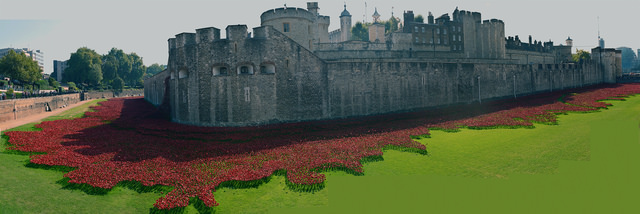
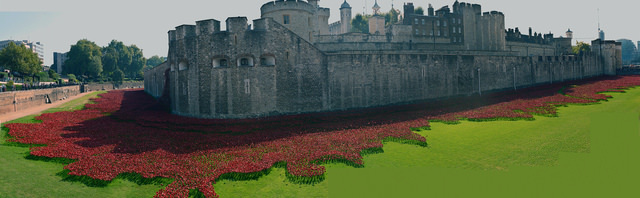
Poppies

Taken by Stu Smith on flikr.com

The 888,246 Tower of London poppies are being removed, even though they were perhaps the most successful art installation ever. They were an effective and moving way to represent the number of British and British colonial soldiers killed in the First World War. The number was astonishing and the poppies were a powerful reminder of the cost in human lives of war, but they represented a small fraction of the total number of lives lost during WW1 – estimated at 10 million military personnel and 7 million civilians. World War Two cost nearly 21 million military and over 27 million civilian lives. The numbers killed in war are beyond comprehension, but they go on rising year by year. It didn’t begin or end with the twentieth century and perhaps it never will end, so removing the poppies is as significant to their meaning as placing them was – human life is frail and transient.
I don’t know how to make people live in peace. Some people claim to know, but I suspect that their answer is that everyone should be like them. But I do think there are some clues to the way. For example when Jesus was asked, “who is my neighbour that I should love as I love myself?” he replied with a story about how a man who was an enemy from Samaria helped a man who had been attacked and robbed on a road out of Jerusalem. The despised Samaritan proved to be the neighbour who should be loved.

Chris Ivory, St Margaret’s Church

Defending the poor

poor
Imagine this. You’re walking through the market one day and in the distance you can hear a growing commotion. The sound of animals charging, birds flapping, coins flying, tables crashing, traders shouting… and one voice above them all. Jesus, armed with a whip of cords, brimming with righteous anger at the injustice around him. We see this picture in the Bible

You see, these traders preyed on the poor, selling overpriced doves to people who couldn’t afford bigger sacrifices, forcing punters to use temple currency, exchanged at extortionate rates.

Two thousand years later and you have to ask two questions. Firstly: do the poor get a just deal? Is it just that the Foodbank is the town’s fast-growing charity? Is it just that they distributed 26 tonnes of food in the last year – almost as much as in the previous two years combined? Is it just that people rely on the generosity of friends because nobody can give them a straight answer about their benefit claim? Is it just that someone who can’t afford £175 for a washing machine has little option but to pay £7 a week for three years (that’s £1,092 in total)? Is it just that human trafficking – that’s slavery – exists? And may well exist in a town (or even a street) near you?

Secondly, what’s our response? The Bible tells us “open your mouth, judge righteously; defend the rights of the poor”. If you have any kind of a voice – a vote, a group of friends, a position of influence, a place on a voluntary committee, a Facebook or Twitter account – think: how can you use your voice? To speak up for the 2,000 people illegally trafficked into the UK each year? To speak up for those trapped in a cycle of debt and poverty?

Now, I’m not suggesting you go into a well-known rent-to-own retailer and start pulling plasma-screen TVs off the walls. But consider the world immediately around you and consider how you can be the voice for people who don’t get to be heard.

Andy King, The Gateway Church

God on Monday

‘God on Monday’ was written in 1966 by the Reverend Simon Phipps, when he was industrial chaplain in Coventry. A holder of the Military Cross, he became an Anglican clergyman convinced of the need to engage with the world, to be involved with the issues of everyday life. For him religion did not end with Sunday, but daily the Church had to give a Christ inspired view on urban and industrial situations. He discussed issues of social responsibility with trade unionists and employers, seeking a just solution to social problems.
Much earlier, in 1891, Pope Leo XIII published his encycyclical ‘Rerum Novarum’ (‘of revolutionary change’). This supported the right of workers to form unions, and rejected both communism and unrestricted capitalism, yet, affirming the right to private property. He stressed the need for a living wage.
Succeeding popes reiterated these views. A century after ‘Rerum Novarum’ St John Paul II published ‘Centesimus Annus’. Drawing on the encyclicals of his predecessors, the Pope stressed that the State must ensure adequate family wages that enable savings to be accumulated, encourage job creation and provide a solid system of social security and support for particularly vulnerable groups, including refugees, immigrants, the elderly, and the sick.
In spite of these Christian demands, we are still in the situation where workers struggle to obtain a living wage, where in work benefits cost the taxpayer £28 billion a year, and people rely on food banks to tide them over.
John Cairns, King’s Lynn Catholic Church

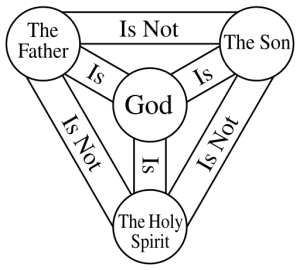
The Trinity; One God; Father, Son and Holy Spirit

Shield-Trinity-Scutum-Fidei-English.svgThe Trinity; One God; Father, Son and Holy Spirit.


God is too big to be defined so what is your understanding of the Trinity? One friend has told me that the Trinity means relationship, a circular goodness or just love. Another way of looking at it is to think of Christ as the bridge between God and man, an eternal triangle.

On page 125 of his book ‘Reaching for the Invisible God’, Philip Yancey writes that the Trinity could be likened to the creative process. The progenitor of reality (God the Father) is the origin of the idea of a creative act; the Son reflects the expression of that idea in reality and the Spirit reflects the recognition in us of the good which that work does for mankind, so that we call it the work of God.

The recent TV program about the research performed by Robert Watson-Watt during the war, leading to the development of radar, exemplifies the creative process. Watson-Watt had the idea of radar and struggled to bring it into reality. Many people, who recognised the benefits of radar, have subsequently contributed to radar and worked with it. They contributed to victory in the Battle of Britain and the subsequent inventions of systems for air traffic control and the microwave oven.

But why bother to include God? Why not say that man invented radar? Perhaps it’s because the potential for radar already existed and man just discovered it.

Peter Coates,

A change of heart brings changed lives

1442152_68557984
We all have a biological heart which constantly pumps blood and oxygen
around our bodies to keep us alive.
We also have another ‘heart’ that is at the centre of our being. This nonbiological
heart is sometimes referred to as our spiritual heart and influences the
person we are and is responsible for the way we feel towards others and towards ourselves.
Our spiritual heart can hold a range of emotions such as love, concern, sympathy, sadness and our need to belong, but can also harbour negative and sinful attitudes like bitterness, anger, hate and unforgiveness. Such negative attitudes often put us at enmity with others.
The Bible tells us that God knows the content of our spiritual heart, whether we have space and time for God and others, or whether we deny everything about God and give no consideration to our creator.
Jesus tells us that our natural hearts are alienated towards God and because of this, God has promised to give a new heart and a new spirit to everyone who calls on Him in repentance and belief in His Son Jesus.
With a God given new heart (that only God can give), our lives will see a change
that we didn’t think was possible as we begin to show greater kindness and
compassion towards others.
We should all take a few minutes to examine the contents of our spiritual heart
and if we find no space in our lives for God, it may be time to consider a change
of direction and a brand new start.
Geoff Duncombe
The Gateway Church, King’s Lynn

What hurts the most?

who-cares
Over the summer, we asked hundreds of local people “What hurts the most?” as part of a Norfolk wide mission called “Who cares?”. Churches care about what hurts the most, because God cares. The results were fascinating and heartbreaking. Each area of Norfolk had slightly different hurts. In West Norfolk, one man wrote, “What hurts the most? Watching my wife suffer from brain cancer.” Others recorded loneliness and relationship pain, while another woman shared about losing her child over two years ago.
More than 13 percent of residents suffer from relationship issues,  while another 12 percent deal with the death of a friend or loved one on a daily basis. The results ran the gamut from abuse and racism to family issues and work problems, but all had one thing in common: they simply need someone to care.
As churches we do care and we believe that God has the answers to our every need and pain – There is hope. Jesus Christ came with a message of hope, reconciliation and healing. He died and rose again to prove it. If you need someone to care for what hurts the most, why not check out a local church this Sunday or take a look at http://www.who-cares.org.uk/who-cares-near-me/