100% Death Rate

1414416_28489993

What do you feel about the health controllers who want to legislate our food into being good for us? Those who want to ban salt in processed food, for example. They tell us how many thousands of lives will be saved if we all follow their directives. I’m all in favour of healthy eating and when I get my fish and chips I like to put the salt and vinegar on them myself! But the serious point is the fallacy that we can make ourselves immortal. The death rate is 100% – we shall all die and ignoring that truth doesn’t help live a full life.
We shall all die and how we face that truth affects how we live our lives now. Is death extinction, or a new and greater adventure in life? Our answer that question makes a great deal of difference to how we live every day. I dislike Henry Scott-Holland’s poem, “All is Well.” It begins “death is nothing at all,” but it is taken to mean, “bereavement is nothing at all,” which it certainly isn’t. Grief is devastating and trying to pretend that the death of someone we love doesn’t affect us is no way to find healing. But if there is infinitely more to life than surviving another day, then each day can be illuminated by the reality of eternal life. That is the hope and the joy that Jesus offers.
Chris Ivory
King’s Lynn Minster

Foodbanks

In 2000, Paddy Henderson received a call from a mother in Salisbury, while fundraising for Bulgaria. She told him ‘my children are going to bed hungry tonight – what are you going to do about it’. Shocked to find on investigation that so many local people faced short term hunger resulting from sudden crises, Paddy started a foodbank in his garden shed providing three days of emergency food to local people in critical need.
In 2004 Paddy Henderson and his wife set up the Trussel Trust on the model that he had already developed. So the UK foodbank was launched teaching churches and communities how to set up their own foodbank.
Helped by churches, schools, individuals, Borough Council, businesses, charities and, especially, by individuals our local Trussel Trust foodbank based in the Purfleet Trust has helped to provide food for 1456 people in crisis (a tonne of food per month).

Next year, increased household bills, potential job losses, especially in the public sector, and welfare reform will increase the demand.

We can put the question to ourselves: what are we going to do about it?
John Cairns

Frustration?

Frustration from www.sxc.hu

Have you ever had that feeling that you really want to thump someone. Have you ever been so
frustrated at a situation, or a person that all of your civilised 21st century ways go out the window
and you just want to punch someone?
When Jesus came into the Temple and saw what people were using the house of God for –
money lending, trading and similar, he was so frustrated, so passionately against what they were
doing that he took action. That’s an understatement, he wrecked up the place, driving the people
out, and turning over the tables.
There are plenty of things in our world that cause us frustration, and give us that feeling that we
just have to do something or we’ll go crazy. Unfortunately most of them are fairly petty concerns
to do with work or similar, when in our world there are much bigger concerns to get frustrated
about. Poverty, curable diseases running rampant, children as young as seven being sold into
sexual slavery. Surely that’s worth shouting about, worth getting frustrated about, worth tipping
over some tables about?
Just please don’t punch anyone!
Kieran Woodward – Assistant Leader King’s Lynn Baptist Church

Being Good isn’t good enough

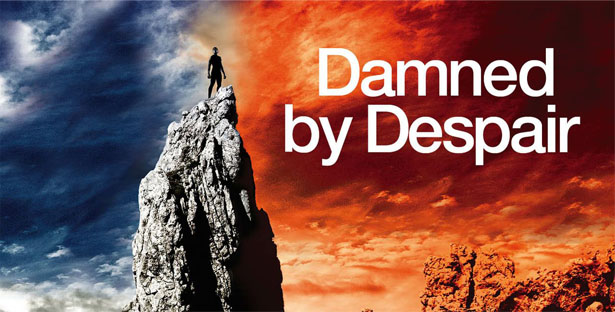
Damned by Despair
Why do people think Christianity is about being good? It isn’t. Being good or bad is not the point. Being loving might be the outcome, but not the starting point.
Recently I saw a play called “Damned by Despair” – a new version by Frank McGuiness of a play written in about 1635. Paulo is a monk living in the desert being very holy. Enrico leads a city gang and is as bad as possible. Paulo is certain God will have to let him into heaven, but the devil, disguised as an angel, tells him to find Enrico because his fate will be the same as Enrico’s. “If Enrico goes to heaven, that’s where you’ll go, if Enrico goes to hell, you likewise.”
Paulo is sure Enrico must go to hell. Therefore, according to the angel, so will Paulo. So what’s the point of being good – he might as well enjoy himself being as bad as he can!
Enrico is condemned to death, but still believes in God. Persuaded by his father, he turns to God and repents. He’s hanged, and goes to heaven. Paulo is too proud to repent. If God is so unjust as not to let him into heaven when he was being good, he’s not going to ask forgiveness for being bad. Paulo is shot, and goes to hell.
What kind of sense does that make of Christianity?!
About the year 400 there was a very nice Scotsman call Pelagius. He went to Rome and became a popular Christian teacher. He taught people that following Jesus was about being good. There was also a man called Augustine. He’d been a bad lad in his youth and realised it wasn’t as simple as that. We are a mess of good and bad. Our motives are always mixed and we can’t make ourselves good – only God can do it. Christians argued about this for decades, but in the end, they decided Augustine was right.
It’s like at Alcoholics Anonymous, the first step has to be admitting we have a problem we can’t sort out on our own – we need help. Trying to do it on our own, doesn’t work.
Sin is not about morality, it’s about the fact that we are broken. Christianity is about realising that only God can mend us, and he does it in Jesus because he wants to, not because we deserve it.
Canon Chris Ivory
King’s Lynn Minster

White Rabbits

White rabbit from www.sxc.hu by donzeladef
There are just too many white rabbits about! – No, not literally rabbits that are white – but the sort of folk that rush about constantly telling everyone else how busy they are.
Last week, while waiting for a meeting to start, a colleague said “there just aren’t enough hours in the day.” She was out of breath and clearly under stress. On the other hand, a previous boss of mine – many, many years ago, told me that if, at the end of a day, if you asked yourself “could I have done anything more, or better” and the answer was “no”, then why worry about what you DIDN’T do! It took me many years to really take that advice on board.
What I now realise is that the important “things” that I prioritise are people – hopefully my family first – but apologies when I get THAT wrong! Not that other tasks are not important – but many things can be left. I now find life gives me unexpected “windows” of time to do things I thought would take ages to achieve. I also enjoy having to wait (usually!). If unprepared I will sit/stand and think through things. I will think about the people who are either important to me or who may be needing me to do something. As a Christian I frequently use this time to pray – for the same people just mentioned. I am often asked to pray for someone or someone’s relations. Or if anticipating a wait – at an appointment, for example, I will take a book or my kindle and enjoy the chance to read in peace. People usually apologise for keeping me waiting, but I really don’t mind!
“Wasting time” is such a silly phrase. Are we so important that we think we are indispensable. Sometimes is just sitting around, or having a drink with a friend or friends, reading the newspaper or a book, pottering in the garden, writing a letter/email to friends not as important as other things that we HAVE to do – or think we have to do.
Yes we need to do certain things – but not at the expense of the people we love and others who really do need our time.